
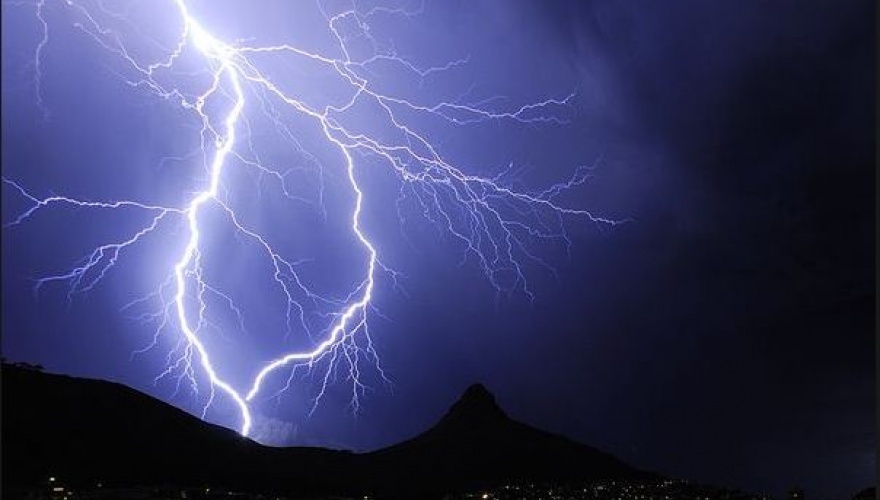
"And among His Signs He shows you the lightning by way both of fear and of hope and He sends down rain from the sky and with it gives. " (Q30: 24)
Lightning is the visible discharge of atmospheric electricity that occurs when a region of the atmosphere acquires an electrical Charge sufficient to overcome the resistance of the air. Lightning is usually associated with thunderclouds but also occurs in snowstorms and dust storms, and sometimes in the dust and gases emitted from erupting volcanoes.
During a thunderstorm, a lightning flash can occur within a cloud; between clouds; between a cloud and air, or from cloud to ground. The flash of cloud-to-ground lightning is initiated by the neutralization of the small net-positive charge in the lowest region of the cloud.
A cloud-to ground flash comprises at least two strokes: a leader stroke and a return stroke. A leader stroke carrying a negative charge passes from cloud to ground. (Occasionally, however, the leader stroke is from ground to cloud--especially with very high structures such as church steeples, multistory buildings, or tall trees.) The leader stroke is not very bright, is often stepped, and has many branches extending out from the main channel.
As it nears the ground, it induces an opposite charge, concentrated at the point to be struck, and a return stroke carrying a positive charge from ground to cloud is generated through the channel. The two strokes generally meet about50 m (164 feet) above the ground. At this juncture, the cloud is short circuited to the ground and a higl1y luminous return stroke of high current passes through the channel to the cloud. A typical lightning flash involves a potential difference between cloud and ground of several hundred million volts, with peak currents on the order of 20,000 amperes. Temperatures in the channels are on the order of 30.000 K (50,000 OF).
The entire process is very rapid; the leader stroke reaches the juncture point or the ground in about 20 milliseconds, and the return stroke reaches the cloud in about 70 microseconds. Thunder is the sound associated with lightning. It is caused by the rapid heating of air to high temperatures along the whole length of the lightning channel. The air thus heated expands at supersonic speeds, but within a metre or two the shock wave decays into a sound wave, which is then modified by the intervening medium of air and topography.
The result is a series of claps and rumbles. Although lightning strikes are dangerous because of their high-voltage discharges, the tendency of strikes to occur at high points enables lightning rods of conductive metal to draw the strikes and conduct them harmlessly into the ground. By moving indoors or by sheltering in a low, depressed area, such as a ditch, exposed persons can avoid being struck.
This article was culled from the publications of Deen Communication Limited