
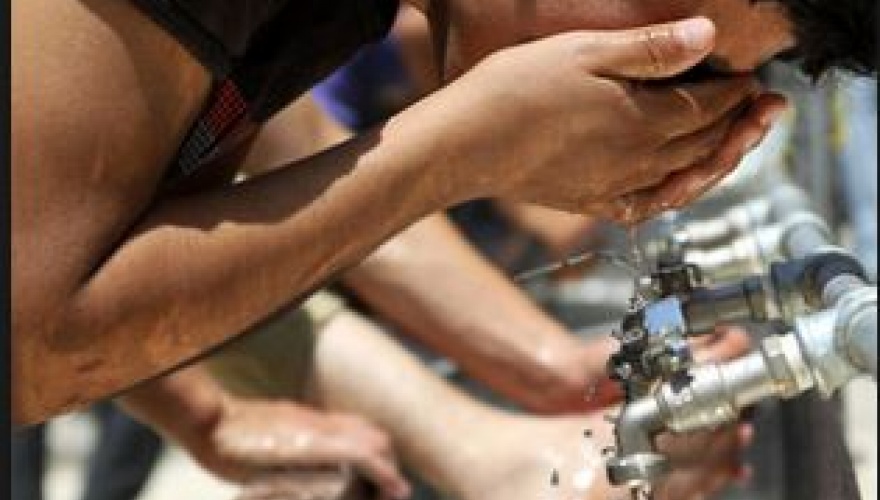
Purification
Purification (at-Taharah) in the language is cleanliness, and keeping free from states of impurity. In the terminology of Shariah (legislation): removing a state of impurity or removing impurities. Types of water All water which descends from the sky or comes out from earth is pure and purifying (tahoor). This is in accordance with the saying of Allah, the Most High: "And We sent down from the clouds water which is pure and purifying."(Q25[Furqan]:48).
Also, due to the saying of the Prophet (salallahu alayhi wa sallam) with regard to the ocean: "It is pure and purifying with regard to its water, lawful with regard to its animals which die." (Ibn Majah - saheeh) The Messenger of Allah also said with regard to the well: "Water is pure and purifying and nothing causes it to become impure." (Abu Dawud - saheeh) Water is not judged to be impure even if impurity falls into it, unless it causes a change in it (i.e. a change in its taste, smell or colour). This is due to the hadeeth of Abu Saeed al-Khudree who said: "O Messenger of Allah! Shall we perform wudoo (ablution) from the well of Budaaah (a well in Madeenah)? (and it was a well into which menstrual rags, carcass of dogs, and foul-smelling things became carried)." So Allah's Messenger said: "Water is pure and purifying and nothing causes it to become impure.
Najaasaat (Impurities)
Definition: Najaasaat is the plural of najaasah, which means everything considered unclean by people of sound fitrah from which they protect themselves and clean their clothes when they are soiled by them such as faeces and urine.
Rule: Essentially, all things are considered permissible and pure and so, whoever wishes to claim that a particular thing is impure, then he must produce an evidence for it, and if he is unable to do so, or he brings a proof which is not acceptable, then we must return to what the natural law holds, that it is pure. Based on this if someone wants to pray on the pavement he can do so as it is pure unless someone can prove that it is not.
some of the Examples are:
1) Urine of human beings
Evidence: Hadeeth: Anas (RA) narrated: "A Bedouin man urinated in the masjid and some of the people rose up to seize him, but the Messenger of Allaah (sallallahu alaihi wa sallam) said: "Leave him, and do not interrupt him." Anas (RA) said: "So when he went out, he called for a bucket of water and poured it upon it (the urine)." (Bukhari and Muslim)
Exception to human urine being najas is the urine of the male baby who is unweaned and hasnt eaten solid food yet. The evidence for this is the hdeeth narrated by Ali Bin Abi Taalib (RA) who said: The Prophet (sallallahu alaihi wa sallam) said: "The female baby, if her urine comes on the clothes then it must be washed but with the male sprinkle some water." (Ahmad, Abu Dawood and others al-Albaanee saheeh).
2) Human excrement Evidence
Abu Hurayrah (RA) said: The Prophet (sallallahu alaihi wa sallam) said: "If any of you prays in his shoes and steps on al adha (harm, excrement, filth etc.), the earth is a purification for it. " (Abu Dawood - AI-Albaanee says: Saheeh)
3) AI-Wady
White and thick non-sticky secretion that is discharged by both the male and female sexual organs after urination without stimulation. This is a common thing and the person is not aware when it happens. No need to make ghusl after this occurs but just wash the private parts and make wudhu - (see evidence below)
4) AI-Madhee
A white, thin, sticky secretion discharged by both the male and female sexual organs without stimulation - when thinking about intercourse or foreplay or anything related to it. The person does not feel it being discharged. Both AI-Wady and AI-Madhee are considered najas because the Prophet (sallallahu alaihi wa sallam) ordered the penis to be washed when they occur.
Evidence: Hadeeth: Alee (RA): "I was a person who suffered from penile discharge and was embarrassed to ask the Prophet (sallallahu alaihi wa sallam) because of my position with respect to his daughter (i.e. son-inlaw of the Prophet (sallallahu alaihi wa sallam. So I told AI-Miqdaad Ibn al-Aswad to ask him for me and so AI-Maqdaad asked him and he said: "Let him make ablution and wash his penis." (Bukhari)
Evidence: Hadeeth: Ibn Abbaas (RA) reported that the Prophet (sallallahu alaihi wa sallam) said: "Al-Mani (sperm), al-Wady and al-Madhee: As for al-Mani, it requires ghusl; and as for al-Wady and al-Madhee, wash your penis and your testicles and then make wudhu as you would for prayer." (AI-Bayhaqi, Abu Dawood)
This article was culled from the publications of Deen Communication Limited